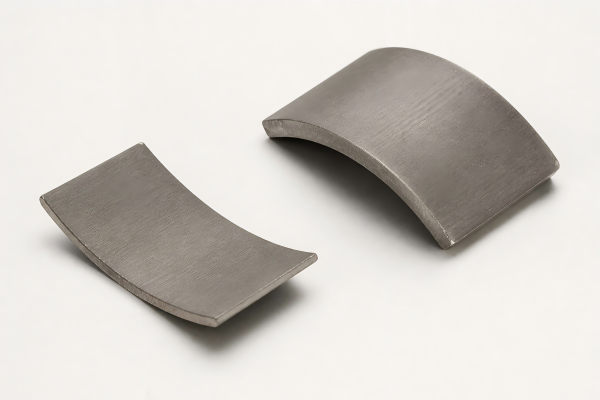
SmFeN Magnets
Contact Us Now
The following values are indicative ranges for finished bonded magnets. Final properties depend on SmFeN powder grade, orientation, filler loading, binder system, molding method, magnetization fixture and part geometry.
| Magnet Type | Process Route | Br (T) | Br (kGs) | Hcj (kA/m) | Hcj (kOe) | (BH)max (kJ/m³) | (BH)max (MGOe) | Typical Working Temp. (°C) | Typical Use |
|---|---|---|---|---|---|---|---|---|---|
| SmFeN Bonded | Injection molded | 0.45-0.70 | 4.5-7.0 | 600-1200 | 7.5-15.1 | 35-75 | 4.4-9.4 | 100-140 | Complex small rotors, sensors |
| SmFeN Bonded | Compression molded | 0.65-0.90 | 6.5-9.0 | 700-1400 | 8.8-17.6 | 70-130 | 8.8-16.3 | 120-160 | Higher output bonded magnets |
| Anisotropic SmFeN | Oriented bonded | 0.75-1.00 | 7.5-10.0 | 800-1500 | 10.1-18.9 | 90-160 | 11.3-20.1 | 120-160 | Precision multi-pole parts |
| Hybrid Bonded | SmFeN + other powder | By design | By design | By design | By design | By design | By design | By binder | Cost/performance balance |
| Custom Compound | Application-specific | By test | By test | By test | By test | By test | By test | By system | Drawing-based magnetic design |
| Parameter | Typical Range / Option | Engineering Note |
|---|---|---|
| Magnetic Phase | Sm-Fe-N, commonly Sm2Fe17Nx | Powder quality and nitrogen content influence magnetic performance. |
| Binder System | PA, PPS, epoxy or custom polymer matrix | Binder determines molding behavior, temperature capability and mechanical strength. |
| Density | Approx. 4.5-6.2 g/cm³ for bonded magnets | Depends on powder loading, binder and molding pressure. |
| Electrical Resistivity | High compared with sintered metallic magnets | Useful where eddy current loss needs to be reduced. |
| Corrosion Behavior | Generally favorable in bonded form | Final resistance depends on binder, surface exposure and operating environment. |
| Temperature Limit | Usually binder-limited | Confirm by thermal aging, flux loss and mechanical retention tests. |
| Magnetization | Axial, diametrical, radial support, multi-pole pattern | Fixture design is critical for molded rings, rotors and encoder magnets. |
| Item | Available Options | Engineering Notes |
|---|---|---|
| Shape | Ring, disc, cylinder, rotor, arc, segment, gear-like profile, insert-molded component and custom shape | Bonded process supports geometry that is difficult for brittle sintered magnets. |
| Process | Injection molding, compression molding, oriented molding, insert molding and custom compound route | Process choice depends on magnetic output, shape complexity, tooling cost and volume. |
| Magnetization | Axial, diametrical, radial support, inner/outer multi-pole, skewed pole and encoder pattern | Multi-pole patterns should be confirmed with fixture design and magnetic scan. |
| Tolerance | Molded tolerance, post-machining support, ID/OD control, runout and concentricity inspection | Critical dimensions should be reviewed together with mold shrinkage and fixture positioning. |
| Surface / Assembly | As-molded, coated, insert molded, shaft overmolded, bonded into housing or assembled with metal/plastic parts | Surface and assembly route should match working environment and retention requirement. |
| Inspection | Dimension, surface flux, magnetic moment, pole map, polarity, runout, aging and functional test | Inspection method should match the magnetic function of the final component. |
For faster review, please provide drawing or 3D file, target magnetic output, working temperature, required pole pattern, dimensions and tolerance, application environment, preferred molding process, sample quantity and annual volume. If the material is not fixed, we can compare SmFeN with bonded NdFeB, ferrite or other magnet options based on performance, cost and production risk.