
Motor Magnet Material Selection
SmCo vs High-Temperature NdFeB Magnets for Motor Rotors
An engineering comparison of torque density, coercivity, temperature stability, corrosion behavior and production risk for demanding permanent magnet motor applications.
The strongest room-temperature magnet is not always the safest rotor choice
High-temperature NdFeB can provide excellent torque density in a compact rotor, while SmCo offers lower reversible temperature loss and strong long-term stability at elevated temperature. The correct choice depends on the full magnetic load line, rotor cooling, peak current, mechanical retention, corrosion exposure and production process.
A motor designer should compare both materials at the actual magnet temperature rather than relying only on room-temperature remanence. Rotor hot spots, inverter fault current, field weakening, adhesive cure temperature and overspeed conditions can all change the available demagnetization margin.
Materials and rotor forms included in the selection review
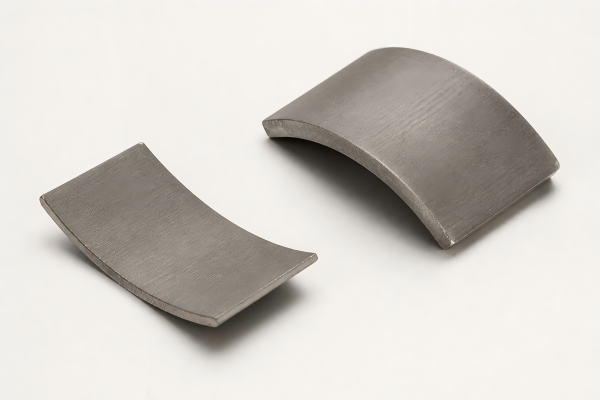
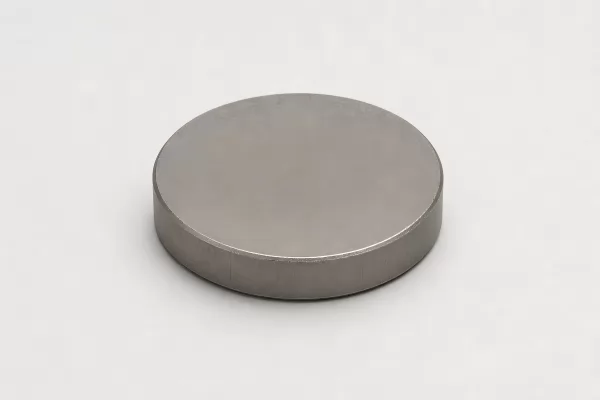
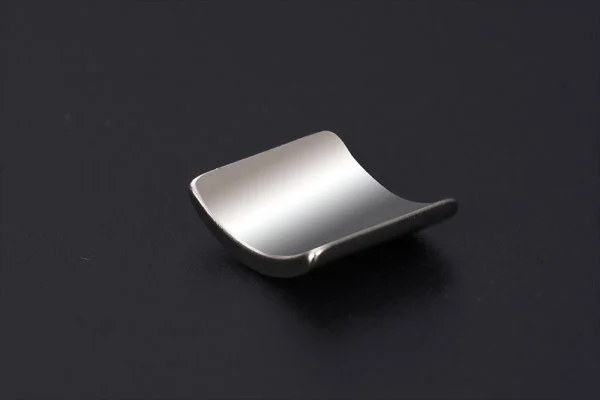
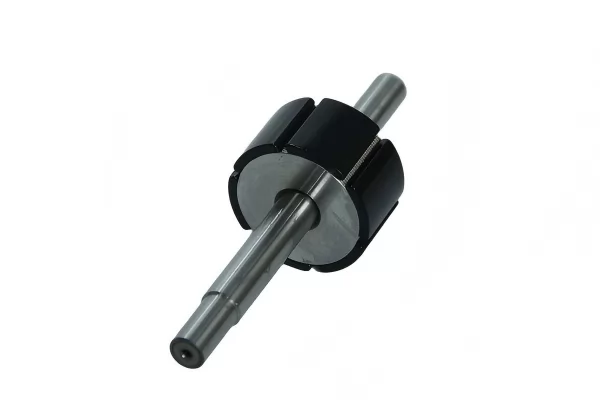
How the material families differ
| Selection Factor | High-Temperature NdFeB | SmCo | Motor Design Implication |
|---|---|---|---|
| Room-temperature flux density | Generally higher | Moderate to high | NdFeB often enables higher torque density or a smaller magnetic volume. |
| Reversible temperature coefficient of Br | Typically about -0.10 to -0.12%/°C | Typically about -0.03 to -0.04%/°C | SmCo usually retains flux more consistently as temperature changes. |
| Typical maximum service temperature | Often 150-220°C for selected grades and suitable geometry | Often 250-350°C, grade and design dependent | Service limit must be confirmed from the operating point, not the grade name alone. |
| Corrosion resistance | Usually requires coating or environmental protection | Generally better intrinsic resistance | Humidity, salt, chemicals and damaged edges influence protection strategy. |
| Mechanical behavior | Brittle; coating and edges require care | Brittle and often more sensitive to impact or chipping | Both need controlled handling, chamfers, bonding and retention. |
| Commercial consideration | Broad grade availability and often lower system cost | Premium material for specialized operating conditions | Compare total rotor cost, cooling, coating and reliability, not magnet price alone. |
Data note: Values above are typical family-level guidance. Exact Br, Hcj, temperature coefficients and service limits vary by grade, geometry, supplier specification and magnetic operating point.
Four questions that narrow the material choice
What is the real magnet temperature?
Estimate steady-state and transient rotor temperature at rated load, overload, field weakening and cooling-failure conditions. Include local hot spots rather than only coolant temperature.
How much coercivity margin is needed?
Review the magnet load line against peak armature reaction, fault current, assembly temperature and minimum expected magnet properties.
What environment reaches the magnet?
Humidity, salt, process fluid, vacuum, radiation and thermal cycling affect coating, adhesive, sleeve and material selection.
What rotor package is manufacturable?
Magnet fragility, segment count, fixture access, bondline control, sleeve installation, balance correction and inspection must fit the production route.
Typical situations favoring each material
High-temperature NdFeB is often considered when
- maximum torque density and compact size are primary objectives;
- rotor cooling keeps the magnet inside a validated thermal window;
- coating and sealing can control corrosion exposure;
- cost, grade availability and production scale are important;
- high coercivity grades provide sufficient irreversible-loss margin.
SmCo is often considered when
- magnet temperature is high or changes over a wide range;
- stable flux over temperature is especially important;
- vacuum, corrosive or harsh environments reduce coating confidence;
- long-term magnetic stability outweighs maximum room-temperature Br;
- the rotor process can manage brittle material safely.
Material choice changes more than the magnetic model
Magnet geometry
Thickness, pole arc, L/D ratio, segmentation and chamfer affect both demagnetization margin and mechanical handling. A grade cannot be separated from its final shape.
Adhesive and cure cycle
Bond strength, glass-transition temperature, surface preparation and cure temperature must remain compatible with the selected magnet and coating.
Sleeve and air gap
Retention sleeves protect magnets at speed but add magnetic gap and thermal resistance. Conductive sleeves may also introduce eddy-current loss.
Thermal path
Rotor core, shaft, sleeve, air gap and coolant determine magnet temperature. Better cooling may make NdFeB viable; poor heat rejection may favor SmCo.
Recommended comparison workflow
Failure modes to address before release
| Failure Mode | NdFeB Exposure | SmCo Exposure | Suggested Control |
|---|---|---|---|
| Irreversible demagnetization | Elevated temperature plus reverse field can reduce margin | Usually stronger high-temperature stability, still grade dependent | Hot-state load-line analysis and post-test magnetic verification. |
| Corrosion | Coating damage, moisture and edge exposure can be critical | Generally better resistance, but not immune to all media | Material compatibility, coating review, sealing and environmental test. |
| Chipping or cracking | Brittle edges and assembly impact | High brittleness and handling sensitivity | Chamfers, controlled fixtures, contact limits and visual criteria. |
| Bond failure | Coating adhesion and thermal cycling affect the interface | Surface condition and thermal mismatch require validation | Surface preparation, adhesive qualification and witness samples. |
| Rotor overheating | Loss plus reduced coercivity margin at temperature | Higher thermal capability, but motor losses still matter | Coupled electromagnetic-thermal analysis and instrumented motor test. |
Motor programs that commonly require this comparison
High-speed compressorsAerospace actuatorsTraction motorsVacuum pump motorsHigh-temperature servosOil and gas toolsMedical motor modulesIndustrial spindle motors
Information needed for a material selection review
SmCo and high-temperature NdFeB questions
Is SmCo always better above 150°C?
No. The correct choice depends on the exact grade, magnet geometry, load line, reverse field, duty cycle and cooling. Selected NdFeB grades may work well at elevated temperature when sufficient coercivity margin is demonstrated.
Can a higher NdFeB grade replace SmCo directly?
Not necessarily. Higher room-temperature energy product does not guarantee equivalent hot-state coercivity, temperature stability, corrosion behavior or long-term reliability.
Does SmCo need a protective coating?
SmCo often has better intrinsic corrosion resistance than NdFeB and may be used uncoated in suitable environments. A coating or cover may still be selected for cleanliness, handling, specific chemicals or assembly protection.
Which material is better for a high-speed rotor?
Speed alone does not decide the material. Designers must review magnet temperature, eddy-current loss, rotor retention, brittleness, segment geometry, sleeve design and overspeed requirements.
Can Ningbo Vanguard support both magnet options and rotor prototypes?
Yes. Ningbo Vanguard Technologies Co., Ltd can support grade selection, custom magnets, rotor design review, prototype assembly, inspection planning and production-oriented process development.
Engineering Support
Request a Material ReviewCompare motor magnets at the temperature where they must work
Send your motor data, rotor drawing, thermal conditions and performance targets. Our team can review SmCo and high-temperature NdFeB options from magnetic design through prototype validation.


