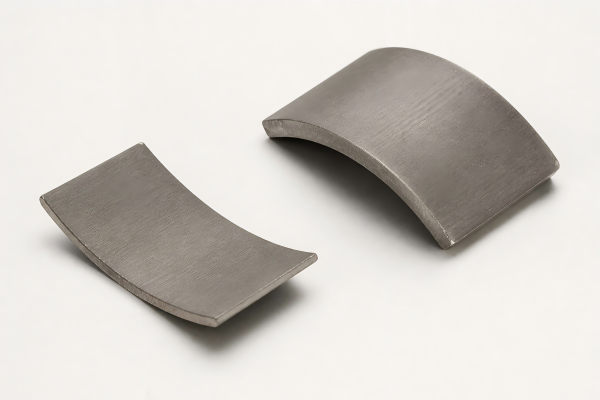
SMC Materials
Contact Us Now
Values below are indicative engineering ranges. Final properties depend on powder grade, insulation coating, particle size, compaction density, heat treatment, core geometry and test condition.
| Material Type | Typical Density (g/cm³) | Saturation Flux Density Bs (T) | Relative Permeability | Coercivity Hc (A/m) | Electrical Resistivity | Main Advantage | Typical Stator Use |
|---|---|---|---|---|---|---|---|
| Standard Fe-based SMC | 7.1-7.4 | 1.5-1.7 | 200-500 | 200-600 | High vs. solid steel | General 3D flux capability | Axial flux / claw pole prototypes |
| High Density SMC | 7.3-7.6 | 1.6-1.8 | 300-700 | 200-700 | High vs. solid steel | Higher magnetic loading | Higher torque density concepts |
| Low Loss SMC | 7.0-7.4 | 1.4-1.7 | 150-500 | 150-500 | Very high particle insulation | Reduced eddy current path | Higher-frequency stator cores |
| High Strength SMC | 7.1-7.5 | 1.4-1.7 | 150-450 | 200-700 | Application dependent | Improved mechanical handling | Segmented stator / assembly parts |
| Custom SMC Grade | By design | By test | By test | By test | By powder system | Application-specific balance | Drawing-based stator design |
| Item | SMC Material Direction | Silicon Steel Lamination Direction | Design Note |
|---|---|---|---|
| Flux Direction | Supports 3D and isotropic flux paths | Best for in-plane laminated flux paths | SMC is strongest when geometry needs 3D flux. |
| Eddy Current | High resistivity from insulated particles | Reduced by thin lamination stack | Compare at actual frequency and flux density. |
| Permeability | Usually lower than laminated steel | Higher permeability and better saturation options | SMC often needs larger magnetic section or topology adjustment. |
| Shape Freedom | Net-shape powder compaction for complex cores | Limited by stamping and stacking direction | SMC can reduce assembly steps in special stators. |
| Mechanical Strength | Depends on density, heat treatment and geometry | Strong stack with proper bonding/welding/riveting | Handling, ejection and assembly stress must be reviewed. |
| Tooling Cost | Compaction tooling required | Stamping tooling or laser/wire EDM route | Volume and geometry decide cost advantage. |
| Item | Available Options | Engineering Notes |
|---|---|---|
| Core Geometry | Axial flux teeth, claw pole, segmented stator, transverse flux core, pole shoe and custom 3D core | Geometry should respect pressing direction, ejection, density distribution and tool life. |
| Material Route | Standard SMC, low-loss SMC, high-density SMC, high-strength SMC and custom powder system | Material choice should be based on flux density, loss target, frequency and mechanical load. |
| Process | Powder preparation, compaction, heat treatment, machining support, impregnation or coating support | Heat treatment and insulation integrity strongly affect core loss and permeability. |
| Integration | Wound stator, segmented assembly, bonded core, overmolded structure and custom fixture assembly | Winding access, insulation clearance and assembly stress should be reviewed early. |
| Inspection | Density, dimensions, strength, permeability, B-H curve, core loss, insulation and visual check | Test plan should match the electromagnetic function and production risk. |
| Validation | Prototype core test, stator assembly test, no-load/loss test, thermal check and functional motor test | SMC parts should be validated at actual frequency, current and thermal condition. |
For faster review, please provide drawing or 3D model, motor topology, target torque/speed, operating frequency, flux density estimate, winding method, working temperature, cooling method, prototype quantity and annual volume. If the material is not fixed, we can compare SMC with silicon steel laminations, amorphous material or other soft magnetic options.