Product Overview
Ring SmCo Magnets
Samarium Cobalt (SmCo) magnets are a class of high-performance rare earth permanent magnets, second only to Neodymium Iron Boron (NdFeB) magnets in magnetic strength, but distinguished by their exceptional high-temperature stability, corrosion resistance, and magnetic reliability. Developed in the 1960s, they quickly became a critical component in industries requiring robust performance under harsh conditions, filling the gap between traditional ferrite magnets and the later-developed NdFeB magnets.
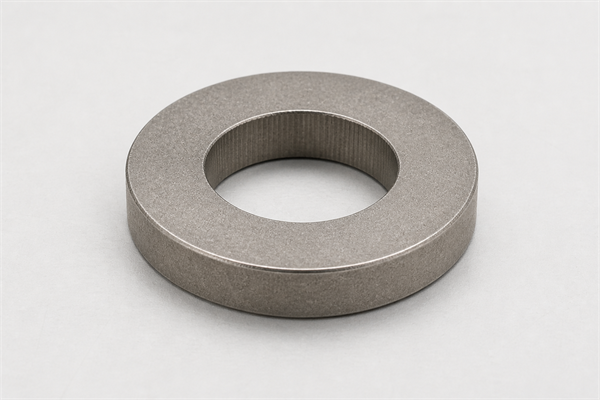
Ring SmCo magnet, also known as samarium-cobalt ring magnet, is a specialized type of rare-earth permanent magnet crafted from an alloy of samarium (Sm), a rare-earth element, and cobalt (Co), a transition metal, often supplemented with trace elements like copper, zirconium, or iron to enhance its performance. Distinguished by its circular, flat structure with a central hole, this magnet is typically measured by its outer diameter (O.D.), inner diameter (I.D.), and thickness (T.), and can also be designed with countersunk holes to meet diverse application needs. As one of the first commercially viable rare-earth magnetic materials, it combines exceptional magnetic performance, superior temperature stability, and strong corrosion resistance, making it indispensable in various high-demand industrial and technological fields.
Ningbo Vanguard Technologies supplies ring magnets across the full grade family — from standard SmCo 1:5 (SmCo5) series through high-temperature SmCo 2:17 (Sm2Co17) series — enabling precise performance matching for each motor operating environment, especially high-temperature applications. All pieces undergo full magnetic testing, dimensional inspection, and salt-spray or HAST corrosion evaluation before shipment.
Whether you need a standard catalogue geometry or a fully custom ring profile, Vanguard can provide sample shipment within 10–15 days and mass-production support for rotor assembly or bare-magnet supply.
Quick View
Ring SmCo Magnet Selection Snapshot
SmCo5 / Sm2Co17
Available Grade Families
SmCo 1:5 and 2:17 grades support high-temperature rings, sensor rotors and precision magnetic assemblies.
250-350 °C
High Temperature Stability
Stable output for aerospace, automotive, downhole, vacuum and high-speed rotating environments.
OD / ID
Ring Geometry Control
Outer diameter, inner diameter, thickness, chamfer, countersink and concentricity can be customized.
10-15 Days
Prototype Sample Lead Time
Fast sampling after drawing, grade, tolerance and magnetization direction are confirmed.
Application Demand Focus
Automotive
Heat resistance
Magnetic Bearings
High speed
1Drawing ReviewOD, ID, thickness, tolerance
2Grade MatchBr, Hcj, thermal stability
3Machining PlanGrinding, chamfer, countersink
4MagnetizationAxial, radial, diametrical, multi-pole
5InspectionFlux, size, polarity, concentricity
Key Applications
In aerospace and aviation, ring SmCo magnets are critical for satellite reaction wheels (attitude control), missile guidance actuators, and radar systems. They operate reliably in space (vacuum, cosmic radiation, cryogenic temperatures) and military-grade shock/vibration, while their lightweight, compact design meets strict weight constraints. Their inherent corrosion resistance eliminates the need for protective coatings in harsh atmospheres.
In electric vehicles (EVs) and advanced automotive systems, ring SmCo magnets complement neodymium in high-temperature sections of traction motors, preventing demagnetization during fast charging. They also power high-temperature sensors for turbochargers and EGR systems, where temperatures exceed 200°C, ensuring safety and performance.
Ring SmCo magnets are used in BLDC motors, servo motors, and generators for high-heat environments (e.g., downhole oil drilling, industrial furnaces, aerospace actuators). Unlike neodymium magnets, they retain over 95% of their magnetic strength at 300–350°C, while their ring shape delivers a uniform radial field that reduces torque ripple and vibration in high-speed rotors. The central hole accommodates shafts or cooling channels, enabling compact, high-power designs.
Magnetic Bearings & Levitation Systems
Ring SmCo magnets enable non-contact magnetic bearings in turbochargers, vacuum pumps, and flywheel energy storage systems. They generate stable axial/radial fields to levitate shafts, eliminating friction and wear, and supporting rotational speeds up to 100,000 RPM. Their thermal stability and rigidity withstand high centrifugal forces, making them ideal for frictionless, energy-efficient high-speed applications.
Medical & Scientific Instruments
Ring SmCo magnets are used in MRI equipment, surgical robots, and NMR spectrometers. They are biocompatible and inert to bodily fluids, suitable for medical devices, and retain magnetic performance at near-absolute zero (-273°C) for cryogenic research. Their precision magnetic fields enable high-resolution imaging and micron-level actuation in surgical robots.
Power Generation
Ring SmCo magnets are used in BLDC motors, servo motors, and generators for high-heat environments (e.g., downhole oil drilling, industrial furnaces, aerospace actuators). Unlike neodymium magnets, they retain over 95% of their magnetic strength at 300–350°C, while their ring shape delivers a uniform radial field that reduces torque ripple and vibration in high-speed rotors. The central hole accommodates shafts or cooling channels, enabling compact, high-power designs.
Grade & Magnetic Properties
Standard grades for ring SmCo magnets. All values at 20 °C. Values are typical; exact grade selection is confirmed per application temperature, magnetic circuit, demagnetizing field, and assembly requirements.
Typical Physical Properties (All Sintered SMCO Grades)
|
Parameters |
Unit |
SmCo5 |
Sm2Co17 |
|
Density / ρ |
g/cm³ |
8.2–8.4 |
8.3–8.5 |
|
Vickers Hardness / HV |
– |
450–500 |
550–600 |
|
Compressive Strength |
MPa |
1000 |
800 |
|
Bending Strength / σ |
MPa |
150–180 |
130–150 |
|
Tensile Strength / σ |
MPa |
400 |
350 |
|
Electrical Resistivity / ρ |
Ω·cm |
(5–6) × 10−5 |
(8–9) × 10−5 |
|
Coefficient of Thermal Expansion / α C⊥ |
10−6/K |
C⊥: 12 |
C⊥: 11 |
|
C∥: 6 |
C∥: 8 |
Magnetization Orientations Available

Coating & Plating Options
Coating of ring SmCo Magnets: While ring SmCo magnets inherently possess excellent corrosion resistance (thanks to their low iron content, unlike NdFeB magnets), optional surface coatings are recommended for specific harsh operating environments to further enhance durability and performance stability. The choice of coating is closely matched to the application scenario, ensuring compatibility with the magnet’s high-temperature resistance and dimensional precision.
Ni·Cu·Ni Triple Layer
Industry standard for clean, low-humidity environments. Bright silver finish.
Most Popular
Zinc (Zn)
Cost-effective general-purpose coating. Dark silver finish. Good for most industrial motors.
Epoxy Resin
Best corrosion and humidity resistance. Charcoal grey. Recommended for EV motor environments.
EV Preferred
Ni·Cu + Epoxy
Triple-layer protection for high-humidity and aggressive environments.
Dimension Capability
Ring magnets are defined by outer diameter (OD), inner diameter (ID), and axial length (L). Standard tolerance is ± 0.05 mm on all dimensions; tight-tolerance ± 0.03 mm is available on request. Concentricity, roundness, chamfer, countersunk holes, slots, and matched-set sorting can be controlled for precision assembly.
|
Dimension |
Minimum |
Maximum |
Standard Tol. |
|
Outer Diameter (OD) |
1.5 mm |
250 mm |
± 0.05 mm |
|
Inner Diameter (ID) |
0.5 mm |
200 mm |
± 0.05 mm |
|
Axial Length (L) |
0.3 mm |
150 mm |
± 0.05 mm |
Design Support
How to Specify Ring SmCo Magnets
Grade Selection
SmCo5 is suitable for stable output and excellent temperature coefficient control. Sm2Co17 is selected for higher energy product, higher working temperature, and stronger demagnetization resistance.
Ring Geometry
OD, ID, axial length, wall thickness, concentricity, roundness, chamfer, and countersunk features should be confirmed together, especially for shaft-mounted or high-speed rotating assemblies.
Magnetization Direction
Axial, radial, diametrical, multi-pole, and custom magnetization patterns can be supplied. Magnetization drawing or pole mark should be confirmed before sampling.
Custom Manufacturing
Available Custom Features
Ring, tube, washer, thin ring, thick-wall ring, countersunk ring, slotted ring, segmented ring, and precision-ground bore.
Motor rotor, magnetic bearing, sensor ring, coupling, high-temperature actuator, scientific instrument.
OD/ID tolerance, concentricity, roundness, parallelism, height matching, surface flux grouping, and batch sorting.
High-speed rotors, low-vibration assemblies, precision shafts, automated bonding, sensor calibration.
Uncoated, passivation, NiCuNi, epoxy, parylene, or application-specific coating after evaluation.
High humidity, chemical exposure, bonding process, clean assembly environment.
Production Control
Manufacturing & Quality Assurance
Ring SmCo magnets are produced through alloy preparation, powder milling, magnetic-field pressing, vacuum sintering, aging heat treatment, core drilling or EDM, ID/OD grinding, slicing, optional coating, magnetization, and final inspection. The process is controlled to maintain magnetic stability, bore accuracy, and reliable assembly fit.
Magnetic Inspection
Br, Hcb, Hcj, (BH)max, surface flux, pole direction, multi-pole distribution, and batch consistency can be tested according to drawing or project specification.
Dimensional Inspection
OD, ID, length, wall thickness, concentricity, roundness, parallelism, chamfer, hole position, and coating thickness are checked before packing.
Documentation
Material certificate, dimensional report, coating report, salt spray result, thermal aging data, and RoHS/REACH documents are available on request.
Fast Quotation
Information Needed for Fast Quotation
For faster engineering review, please provide drawing or 3D file, OD, ID, axial length, tolerance, chamfer or countersunk requirement, grade or working temperature, magnetization direction, coating requirement, operating environment, sample quantity, and annual volume. If the grade is not fixed, our team can recommend a SmCo5 or Sm2Co17 option based on temperature and required magnetic output.
Frequently Asked Questions
When should I choose a ring SmCo magnet over a ring NdFeB magnet?
Choose ring SmCo if your application requires high-temperature operation (above 150°C, up to 550°C), superior corrosion resistance (no need for coating), or resistance to demagnetization in harsh environments (e.g., vibration, chemical exposure).
What is the minimum order quantity for custom ring magnets?
For custom geometry, samples can be arranged from as few as 50–200 pieces. Mass-production MOQ is typically 1000–10000 pieces per specification, though this is flexible depending on magnet size and grade. Contact us to discuss your project volume.
Can you supply ring magnets already assembled into a rotor?
Yes. Vanguard provides integrated rotor assembly services — including magnet bonding, balancing, and shaft press-fitting — as part of our Magnetic Systems product line. We can supply bare ring magnets or complete rotor sub-assemblies depending on your manufacturing flow.
Do you provide material certifications and test reports?
Full material certificates (chemical composition, magnetic test data, coating thickness, salt-spray results) are provided with each shipment as standard. ROHS, REACH, and conflict-mineral declarations are available on request.
What is the lead time for ring SmCo magnets?
Prototype samples: 10–15 working days. Mass-production orders: 25–35 working days depending on grade, coating, and quantity. Rush sampling may be available — please inquire.