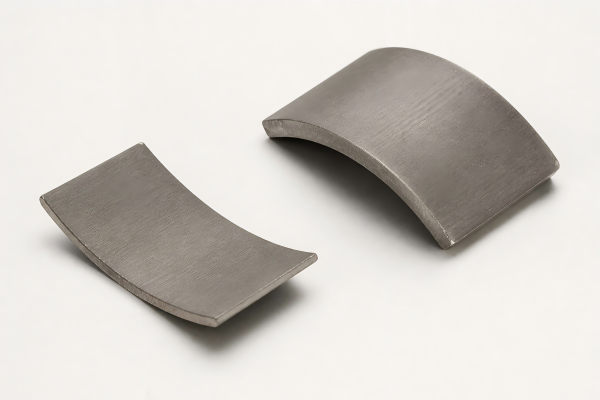
Magnetic Stator Assembly
Contact Us Now
A magnetic stator assembly is the stationary magnetic module used in motors, generators, magnetic couplings, sensors and special electromechanical systems. It can include permanent magnets, laminated steel cores, back iron, stainless sleeves, aluminum housings, adhesive bonding, mechanical retainers, insulation materials and precision positioning features.
Compared with supplying magnets only, a complete magnetic stator assembly helps customers reduce alignment risk, bonding variation and assembly workload. The magnetic circuit, pole layout, air-gap control, thermal path, corrosion protection and mechanical fixing method can be designed together to improve final system performance.
Ningbo Vanguard Technologies supplies custom magnetic stator assemblies using NdFeB, SmCo, ferrite and bonded magnets. We support arc magnet stators, ring magnet stators, segmented stators, Halbach stators, linear stator tracks and fully customized magnetic assemblies with machining, bonding, magnetization, inspection and magnetic performance validation.
Whether you need a prototype magnetic stator assembly for motor development or a batch-ready magnetic stator assembly for production, Vanguard can provide engineering review and sample production within 10-25 days after drawing, magnet grade, pole count, air gap and test requirements are confirmed.
The following structures are commonly used for custom magnetic stator assemblies. Final geometry, pole count, magnet grade and inspection method are confirmed according to drawing and magnetic performance requirements.
| Stator Type | Typical Magnet | Common Pole Count | Housing / Back Iron | Key Feature | Typical Application |
|---|---|---|---|---|---|
| Arc Magnet Stator | NdFeB / SmCo arc segment | 4-48 poles | Steel ring, laminated core, stainless sleeve | High torque density and customizable air-gap flux | BLDC motors, servo motors, generators |
| Ring Magnet Stator | Radial or multi-pole ring magnet | 2-64 poles | Steel shell, aluminum housing, plastic carrier | Compact assembly with simple installation | Sensors, compact motors, pumps |
| Halbach Stator | Segmented NdFeB / SmCo array | Custom pole layout | Nonmagnetic carrier or steel support | Enhanced one-side flux and reduced stray field | High-efficiency motors, linear systems |
| Linear Magnetic Stator | Block, arc or Halbach magnets | Pitch-based array | Steel rail, aluminum base, stainless cover | Long magnetic track with controlled pitch | Linear motors, actuators, transport systems |
| Segmented Carrier Stator | Block / tile / wedge magnets | Custom | Machined steel or aluminum carrier | Flexible assembly for non-standard magnetic circuits | Couplings, test benches, special machines |
| Bonded Magnet Stator | Injection or compression molded magnet | Multi-pole | Plastic or metal insert | Complex pole pattern and integrated geometry | Encoders, small motors, appliance motors |
Vanguard can customize magnetic stator assemblies from magnet-only subassemblies to complete magnetic modules. The table below summarizes common specification items for engineering review.
| Item | Available Options | Engineering Notes |
|---|---|---|
| Magnet Material | NdFeB, SmCo, ferrite, bonded NdFeB, bonded ferrite | Selected according to flux density, temperature, corrosion, cost and demagnetization margin. |
| Magnet Shape | Arc, block, wedge, ring, segment, tile, custom profile | Geometry is matched to air gap, pole pitch, housing and assembly method. |
| Magnetization | Radial, parallel, diametrical, axial, multi-pole, Halbach pattern | Magnetization direction strongly affects field distribution and torque output. |
| Housing / Carrier | Steel, stainless steel, aluminum, laminated core, plastic carrier | Material choice affects magnetic circuit efficiency, corrosion resistance and weight. |
| Fixing Method | Adhesive bonding, mechanical groove, sleeve, retaining ring, overmolding | Bonding and retention must consider centrifugal load, thermal expansion and vibration. |
| Surface Protection | NiCuNi, epoxy, Zn, phosphate, parylene, passivation, custom coating | Coating is selected by magnet material, humidity, salt spray, chemical exposure and temperature. |
| Inspection | Dimension, polarity, surface flux, flux mapping, pull test, runout, balance | Inspection method is customized by motor, generator or sensor performance requirement. |
| Factor | Influence on Performance | Recommended Check |
|---|---|---|
| Air Gap | Small changes can affect flux density, torque output and cogging. | Confirm nominal air gap and tolerance stack-up with rotor or moving part. |
| Pole Position | Angular error can create torque ripple, unbalanced force or sensor signal error. | Use assembly fixtures and polarity inspection for each pole. |
| Temperature | High temperature reduces magnetic output and may affect adhesive strength. | Select suitable magnet grade and verify thermal aging when needed. |
| Back Iron | Insufficient back iron may saturate and reduce usable flux. | Review steel thickness, permeability and magnetic circuit simulation. |
| Coating & Corrosion | Corrosion can damage magnets and reduce long-term reliability. | Choose coating according to humidity, salt spray, coolant or chemical exposure. |
Vanguard can customize magnetic stator outer diameter, inner diameter, pole count, magnet grade, magnetization direction, housing material, bonding process, coating, polarity marking and inspection method. For motor projects, we can support prototype stators for magnetic validation before production tooling.
Assembly support: We provide magnet sorting, magnet bonding, fixture positioning, curing, mechanical retention, sleeve fitting, polarity marking, flux inspection and protective packaging.
Engineering review: If the project involves high speed, high temperature, chemical exposure or tight magnetic uniformity, our engineering team can review material, adhesive and inspection requirements before sampling.
Production begins with drawing review, magnet grade selection and fixture planning. Magnet pieces are machined, coated and sorted, then assembled into the stator housing or carrier with controlled adhesive, mechanical retention or sleeve structure.
Finished magnetic stators are magnetized when required, checked for polarity, dimension, runout, surface flux or flux mapping, and packed with anti-collision protection for safe shipment.
Magnetic inspection: Polarity, surface flux, flux linkage, pole angle, magnetization direction and flux mapping can be checked by requirement.
Dimensional control: OD, ID, height, air-gap surface, roundness, concentricity, runout, slot position and assembly appearance are inspected per drawing.
Reliability checks: Bond strength, coating thickness, salt spray, thermal shock, heat aging and vibration-related checks can be arranged for critical projects.
Documentation: Material certificate, inspection report, magnetic test data, RoHS/REACH declaration and lot traceability records are available.
To speed up engineering review, please provide a 2D/3D drawing or confirm the specifications below. If the design is still under development, Vanguard can help compare magnet material, pole layout and assembly method before sampling.