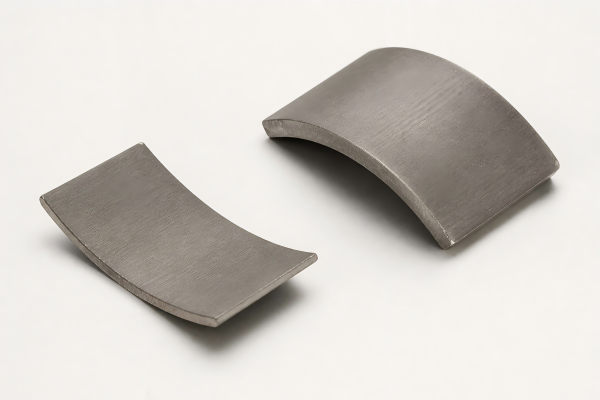
Amorphous Materials
Contact Us Now
Amorphous material is a soft magnetic alloy produced by rapid solidification, forming a non-crystalline atomic structure. Compared with conventional silicon steel, amorphous magnetic material offers very low core loss, high permeability, low coercivity and excellent energy-saving performance in transformers, inductors, reactors, sensors and high-frequency magnetic components.
Common amorphous materials include Fe-based amorphous ribbon, Co-based amorphous alloy, nanocrystalline ribbon and custom soft magnetic alloy systems. These materials are usually supplied as thin ribbon, wound cores, cut cores, C cores, toroidal cores, magnetic shields or custom core assemblies according to application requirements.
Ningbo Vanguard Technologies supplies amorphous and nanocrystalline magnetic materials for power electronics, energy-saving transformers, current sensors, EMI filtering, inverters, reactors and special magnetic assemblies. We support material selection, ribbon width matching, core winding, annealing, cutting, coating, housing, magnetic testing and batch inspection.
Whether you need amorphous ribbon, a prototype wound core or a customized low-loss magnetic component, Vanguard can provide engineering review and sample production within 10-25 days after material grade, size, frequency and magnetic performance requirements are confirmed.
The following material families are commonly used for low-loss magnetic cores. Final grade, ribbon width, core size and annealing condition are confirmed according to frequency, flux density, temperature and loss requirement.
| Material Type | Typical Form | Main Advantage | Frequency Range | Key Feature | Typical Application |
|---|---|---|---|---|---|
| Fe-Based Amorphous Alloy | Ribbon, wound core, cut core | Very low core loss | Power frequency to medium frequency | Energy-saving transformer core material | Distribution transformers, reactors |
| Nanocrystalline Alloy | Ribbon, toroidal core, cut core | High permeability and low loss | Medium to high frequency | Excellent for EMC and sensing | Current transformers, EMI filters |
| Co-Based Amorphous Alloy | Ribbon, sensor core, shield | Low coercivity and high sensitivity | Sensor and high-frequency use | Stable magnetic response | Sensors, magnetic shielding |
| Amorphous Cut Core | C core, rectangular core, custom core | Easy winding and assembly | Power electronics | Custom gap and shape options | Inductors, reactors, transformers |
| Toroidal Nanocrystalline Core | Toroid, coated core, boxed core | High permeability in compact size | High-frequency filtering | Low leakage flux and compact design | Common-mode chokes, sensors |
| Custom Amorphous Assembly | Core with housing, coating, gap or bobbin | Application-ready component | By design | Integrated insulation and protection | OEM power modules, special equipment |
Vanguard can customize amorphous ribbon, nanocrystalline cores and finished magnetic components. The table below summarizes common specification items for engineering review.
| Item | Available Options | Engineering Notes |
|---|---|---|
| Material Family | Fe-based amorphous, Co-based amorphous, nanocrystalline, custom soft magnetic alloy | Selected according to loss, permeability, frequency, saturation and cost target. |
| Product Form | Ribbon, wound core, toroidal core, cut core, C core, rectangular core, custom assembly | Form depends on winding method, air gap, mounting and insulation requirement. |
| Ribbon Width | Standard widths or slit-to-width options | Ribbon width is matched to core height, winding process and loss target. |
| Core Treatment | Stress relief annealing, magnetic field annealing, coating, boxing, epoxy protection | Annealing and protection strongly affect permeability, loss and mechanical durability. |
| Magnetic Properties | Core loss, permeability, coercivity, saturation flux density, remanence | Test criteria should match frequency, induction level and waveform condition. |
| Mechanical Design | OD, ID, height, gap, bobbin, case, mounting holes, leads or terminals | Mechanical structure should match winding, insulation and assembly process. |
| Inspection | Dimension, weight, loss, inductance, permeability, insulation, appearance | Inspection method is customized by transformer, sensor or filter application. |
| Factor | Influence on Performance | Recommended Check |
|---|---|---|
| Flux Density | Higher operating induction increases loss and may approach saturation. | Confirm B value, waveform and safety margin. |
| Frequency | Loss and permeability vary strongly with frequency. | Test core loss and inductance at real operating frequency. |
| Annealing | Improper annealing may reduce permeability or increase coercivity. | Define annealing process and magnetic property target. |
| Mechanical Stress | Stress can change magnetic performance in sensitive amorphous cores. | Use suitable casing, coating and assembly force control. |
| Air Gap | Gap design affects inductance, saturation behavior and energy storage. | Specify gap size and tolerance for reactors or inductors. |
Vanguard can customize material family, ribbon width, core OD, ID, height, gap, coating, casing, bobbin, terminals, annealing process and magnetic test standard. For new power electronics projects, we can help compare amorphous, nanocrystalline, ferrite and silicon steel solutions by loss, size and cost.
Process support: We provide ribbon selection, slitting, core winding, annealing, cutting, coating, boxing, assembly, magnetic testing and protective packaging.
Engineering review: If the project involves high frequency, high current, low standby loss or strict EMC performance, our engineering team can review material, core shape and test conditions before sampling.
Production starts with alloy ribbon selection and core design. Ribbon is slit or selected by width, wound into the required core geometry, annealed under controlled conditions, then cut, coated, boxed or assembled depending on the final application.
Finished cores are inspected for dimension, appearance, loss, inductance, permeability and insulation condition before packaging. Special magnetic testing can be arranged according to customer frequency and waveform requirements.
Magnetic testing: Core loss, permeability, inductance, coercivity, saturation behavior and frequency response can be tested by requirement.
Dimensional control: OD, ID, height, ribbon width, gap, case size and mounting interface are inspected per drawing.
Process verification: Annealing condition, coating, casing, bonding, insulation and appearance are checked according to product type.
Documentation: Material certificate, inspection report, magnetic test data, RoHS/REACH declaration and lot traceability records are available.
To speed up engineering review, please provide a drawing or confirm the specifications below. If the magnetic material is still under selection, Vanguard can help compare amorphous and nanocrystalline options before sampling.